
If you run a business right now, someone has probably asked you about your AI plan. Maybe it was your board. Maybe it was your team. Maybe it was the voice in your head at 2 a.m., wondering whether everyone else has already figured it out.
That’s a lot to sort through alone, and iTeam is built so CEOs don’t have to.
What is iTeam?
iTeam is a network of CEO think tanks. Founder and CEO Thaddeus Rex puts it this way: “I built it to give CEOs a confidential room where they can step out of the day-to-day, think alongside peers who truly understand the job, and go back ready to lead with their edge.”
Here’s how the think tanks work:
- Small and mixed. Each group is 10 to 12 CEOs from different industries.
- Monthly. Groups meet every month around Indianapolis to strategize, collaborate, and hold each other accountable.
- Confidential. Every member signs an NDA, so what’s shared in the room stays in the room. This allows each CEO to feel comfortable having the difficult and vulnerable conversations that they don’t often have the ability to have.
Each meeting follows a set agenda that gives every CEO a turn to share their wins, their struggles, and everything in between. New members join by introduction or by recommendation from an existing member, facilitator, or board advisor. Curious whether an iTeam think tank is a fit for you? Learn more at thinkiteam.com, or email Michelle McCarley at michelle.mccarley@thinkiteam.com.
Our CEO, Drew Linn, has been an iTeam member since 2020 and joined its advisory board in 2021, after exploring other CEO peer groups. Since then, we’ve worked on several technology projects and initiatives that support iTeam and its members.
Why an AI summit?
AI kept coming up in iTeam’s think tanks, and the questions were about leading a company through it:
- How do we keep morale strong while we adopt AI?
- Should AI be part of our company’s vision, and if so, how?
- How do we hold our strategic direction while everything changes this fast?
- What are the risks (ethics, security, legal), and how do we reduce them?
- How do we use AI to put our capital and our team’s time where it matters most?
So iTeam set aside a full day for CEOs only, working through those questions alongside people who build with AI every day. The push came from one of its own members, who challenged iTeam to bring other CEOs to the table and help make AI practical.
Inside the day
The iTeam AI Summit, “How AI is Changing the Way We Lead,” ran from 8:30 to 4:00 on November 4 at the Skyline Club in downtown Indianapolis. It was invite-only for CEOs and business owners, and attendees brought laptops because much of the day was hands-on.
The agenda:
- CEO Strategy & AI: a strategy for AI, and an AI for strategy
- Panel, The Risks of AI: ethics, security, legal exposure, and team morale
- Keynote, “Using AI Agents to Better Prioritize a CEO’s Time”: Mike Kelly of DeveloperTown
- Panel, The Future of AI: what’s changing, what’s lasting, and how CEOs can prepare
- Breakouts: a choice of hands-on AI, AI readiness for the whole team, or amplifying a sales team with AI
Thaddeus moderated both panels. The goal was for every leader to walk out with a clearer view of the risks, ideas for getting their own time back, hands-on practice, and a room full of fellow CEOs to compare notes with.
We were proud to be one of the summit’s sponsors, alongside title sponsors DeveloperTown, Indesign, Van Ausdall & Farrar, and the Skyline Club.
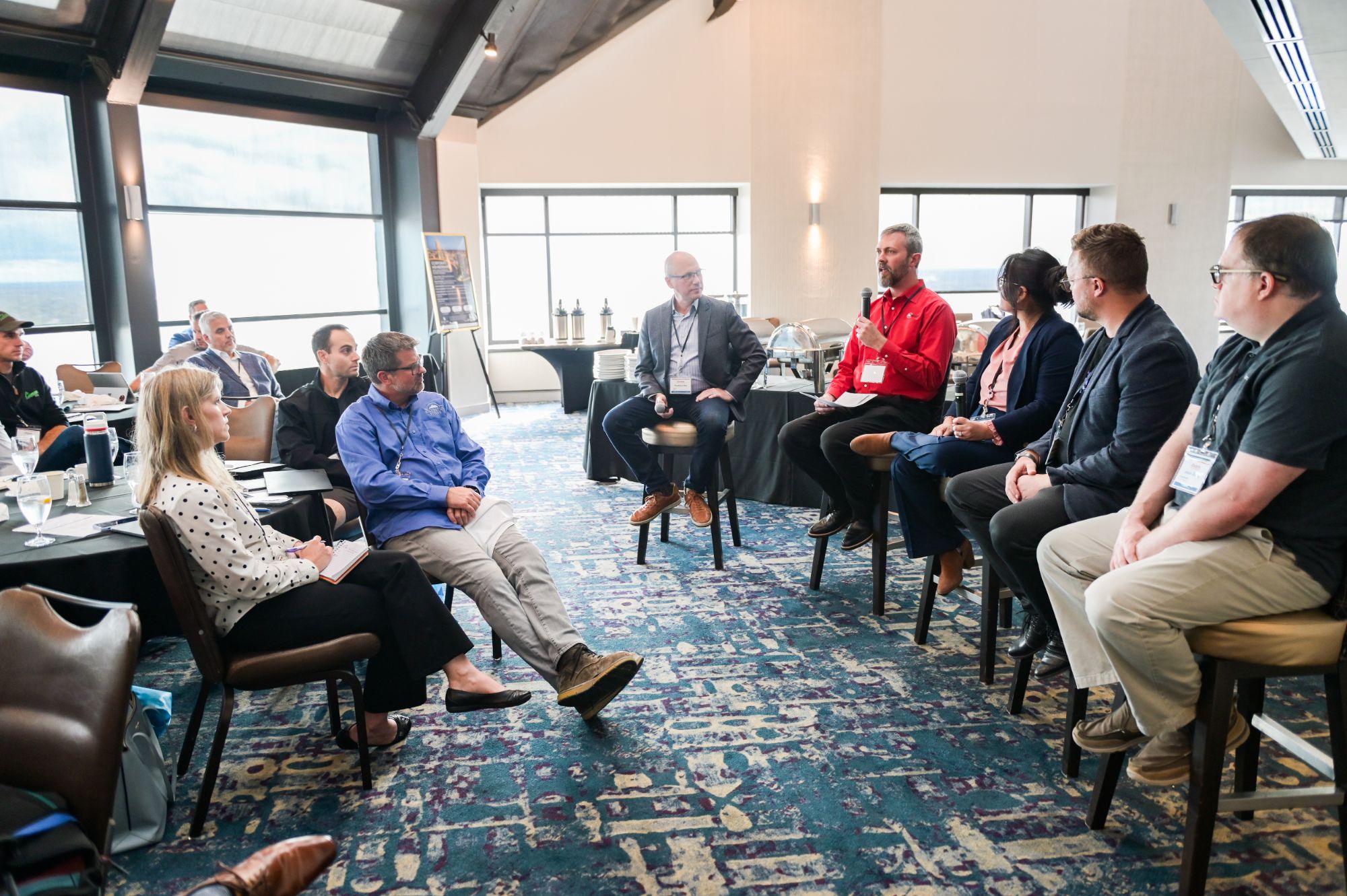
Photo courtesy of iTeam.
Taking the stage
Jason Bourg, our Chief Innovation Officer and Partner, joined leaders from Indesign, Invest Hamilton County, and Collabo XD on The Future of AI panel. iTeam introduced him as “a self-described AI optimist who spends much of his time pushing AI to see what it can do for businesses,” and Jason’s happy to own that. Call it cautious optimism: he takes the risks seriously, and he still sees a lot worth getting excited about.
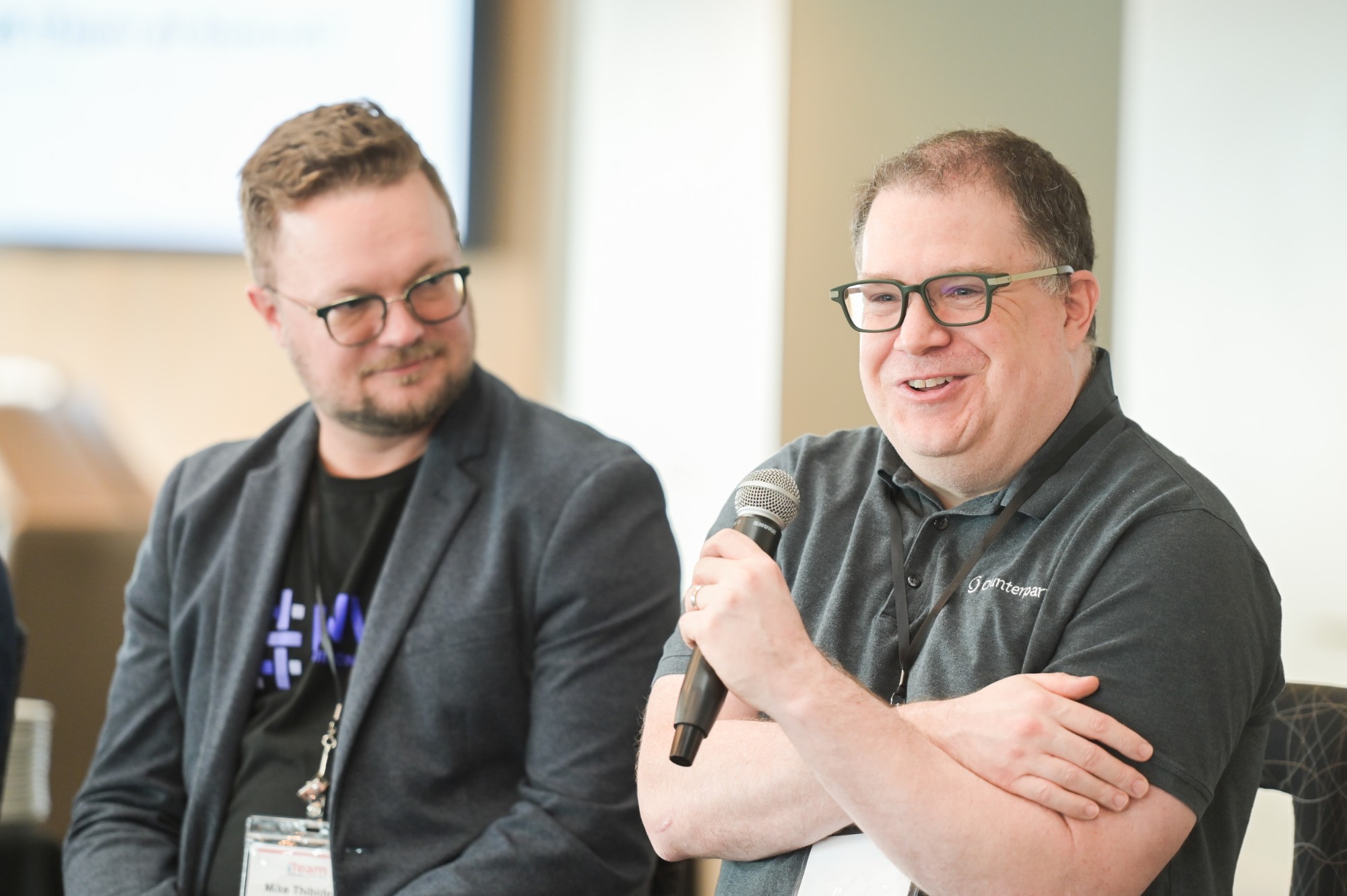
Photo courtesy of iTeam.
Part of that hope comes from a question OpenAI’s Sam Altman has raised: will AI bring another industrial age, or another renaissance? AI is already changing people’s work, and for some, it’s changing their jobs. That’s a hard part of this moment, and it deserves care. Jason hopes AI will also open a new era of creativity and discovery, giving people room to solve problems that have been out of reach. “What I want to fight for is more of a renaissance,” he says.
What Has Jason Excited
Thaddeus asked the panel what excites them most about AI. For Jason, it’s what happens when people and AI work together. AI has already solved math problems people couldn’t crack; it’s taking on physics now, and he can’t wait to see what it does in medicine, from new ways to treat diseases to possible cures.
He expects the people who go furthest to be the ones already at the top of their game. “They’re now given another tool to up their level even higher,” he says.
Jason also shared what he’s hoping for:
- A new kind of mind. Jason’s a computer scientist who has studied how neural networks work, and he’s excited by the idea of AI that reasons in a way that’s hard to tell apart from how people do. He knows there are risks, and as an optimist, he thinks it “could be really, really cool.”
- The Star Trek version. A world where AI and machines cover the basics, like food and a place to live, so people have more freedom to pursue what they love while working alongside AI. Jason’s hoping for “the Star Trek: The Next Generation version of the world,” where “you can just explore the universe if that’s what you want.”
Day to day, he thinks of AI as “a really, really smart, naive coworker.” You can bring it the hardest questions, but it’s “still a baby when it comes to some things.” And “the more I think about it as a coworker and the less I think about it like a tool,” he says, “the more value I’m getting.”
Memory Over Models
Jason’s main message to CEOs was where to put their attention. “A lot of CEOs right now think in terms of models,” he says. “Should I buy Claude? Should I buy ChatGPT? How do I get my team to use this thing?”
He wanted them thinking about memory. Companies used to say data was everything. Jason thinks “memory” is the better word, because it covers three things:
- the data sitting in your applications
- what your people know
- what your AI agents learn as they work
“All of that is the proprietary sauce of what makes your company special,” he says. His advice is to own that memory yourself, in a way any AI model can use, and connect all three so your people, your agents, and your data work together. That makes the agents more effective and the people more effective, and it “puts your data to work.”
The panel also took a question about whether you’d sell your company’s data for AI training. Jason’s answer for Counterpart: it wouldn’t do a buyer much good. Hand our whole knowledge base to another company and tell them to copy us, and they couldn’t, “because there’s so much human that goes into making the Counterpart engine work.”
Fix the Data First
The line that got the biggest reaction was about companies that buy an AI product and expect it to fix everything. Jason asked how many people in the room had bought an AI tool that didn’t deliver, and plenty of them were right there with him.
His explanation: if your data and your people’s know-how are scattered, AI can’t use them either. “If Phil over there just always keeps a spreadsheet on his desktop that no one can see but him, AI can’t see it either,” he says. “You need to solve those problems first,” starting with getting your data into one central place. “Then layer AI on top of it, and that’s when you see the magic happen.”
For more on getting that groundwork in place, read The two steps before you buy an AI tool.
Your Team and Your Time
The question CEOs kept coming back to was their people. Even if I’m on board with AI, how do I get my team there?
The panel’s take was that the people who’ll thrive are the ones who show up asking, “How am I going to innovate today?” Jason thinks AI “basically promotes all humans up to managers. You just happen to be managing both humans and agents.” His advice to the CEOs: find the people who are going to succeed and back them, and give everyone else the chance to build those skills now.
Time came up too. Working with AI agents tends to come in bursts: a few hours of focused direction up front, then hours of the agents working on their own while you step away. Used well, that can hand people back time in their day, for deeper thinking, for the parts of the job they love, or for life outside work. It also makes a 9-to-5 built on counting hours a harder fit. Agents don’t care about clock-in times, Jason points out. They work whenever there’s something for them to do, so the question for leaders becomes how to keep the work moving while people find a rhythm that fits their lives. Jason thinks Counterpart has “been ahead of the game for a while” on this, because we’ve long judged work by its outcome.
One more point stuck with him, from a fellow panelist: an AI degree on its own doesn’t get you far, because what matters is knowing your field well enough to know what you’re asking AI to do. Jason has pushed the same idea at Ivy Tech. He argued for AI training paired with a field, resulting in an AI credential built to go alongside a degree like marketing.
Keeping the conversation going
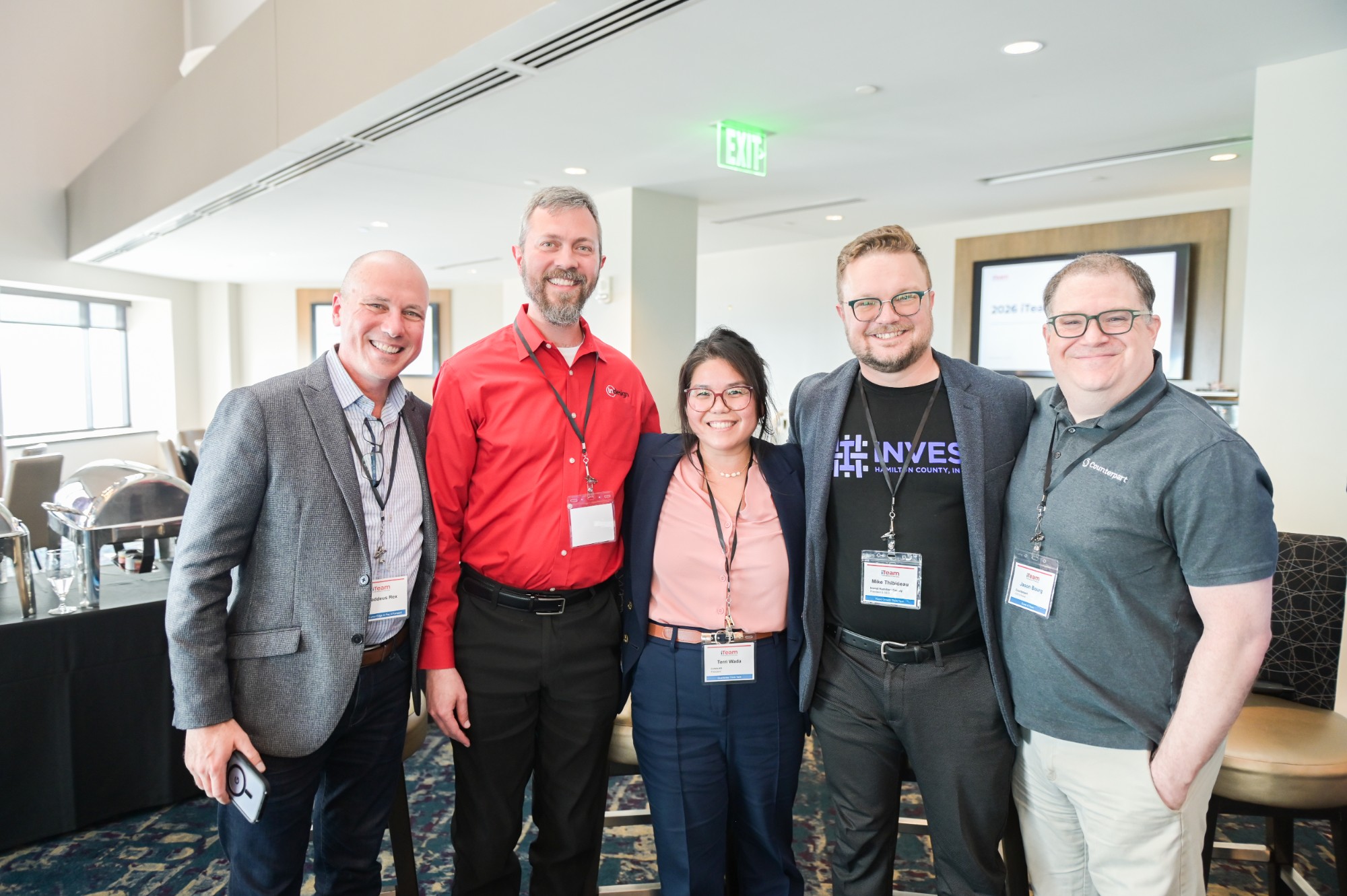
Photo courtesy of iTeam.
Thanks to Thaddeus, Michelle, and the whole iTeam crew for bringing these leaders together. If you’re sorting out where AI fits in your own business, we’d love to help you think it through.