Defining software requirements through documentation alone often leads to confusion. Requirements by Design uses visual design and iterative development to shape requirements as the product takes form, making it easier for teams to stay aligned and build something that actually works for users.
A lot of software projects start the same way. You try to define everything up front. Features, workflows, and edge cases all get written out before anything is built. On paper, that sounds responsible. In practice, it’s where things start to drift.
The details might all be there, but people interpret them differently. Some skim. Some fill in gaps on their own. For non-technical teams in particular, it can be hard to picture how everything will actually work.
Requirements by Design emerged from that gap.
Rather than relying on documentation as the source of truth, it uses design to define the product. Wireframes and UI concepts serve as the means by which requirements are explored, clarified, and agreed upon. That shift changes the conversation. You’re no longer asking people to interpret a description. You’re asking them to react to something they can see and respond to in real time.
Teams often try to solve uncertainty by adding more detail up front. The thinking is: if everything is defined early, fewer things will go wrong later. What actually happens is a little different.
Long documents are hard to absorb, and they rarely translate into a shared understanding of how the product will work. Once development starts, changes feel heavier because everything ties back to what was written at the beginning. So even with the requirements in place, misalignment still shows up. That’s where a more visual, iterative approach starts to make a difference.
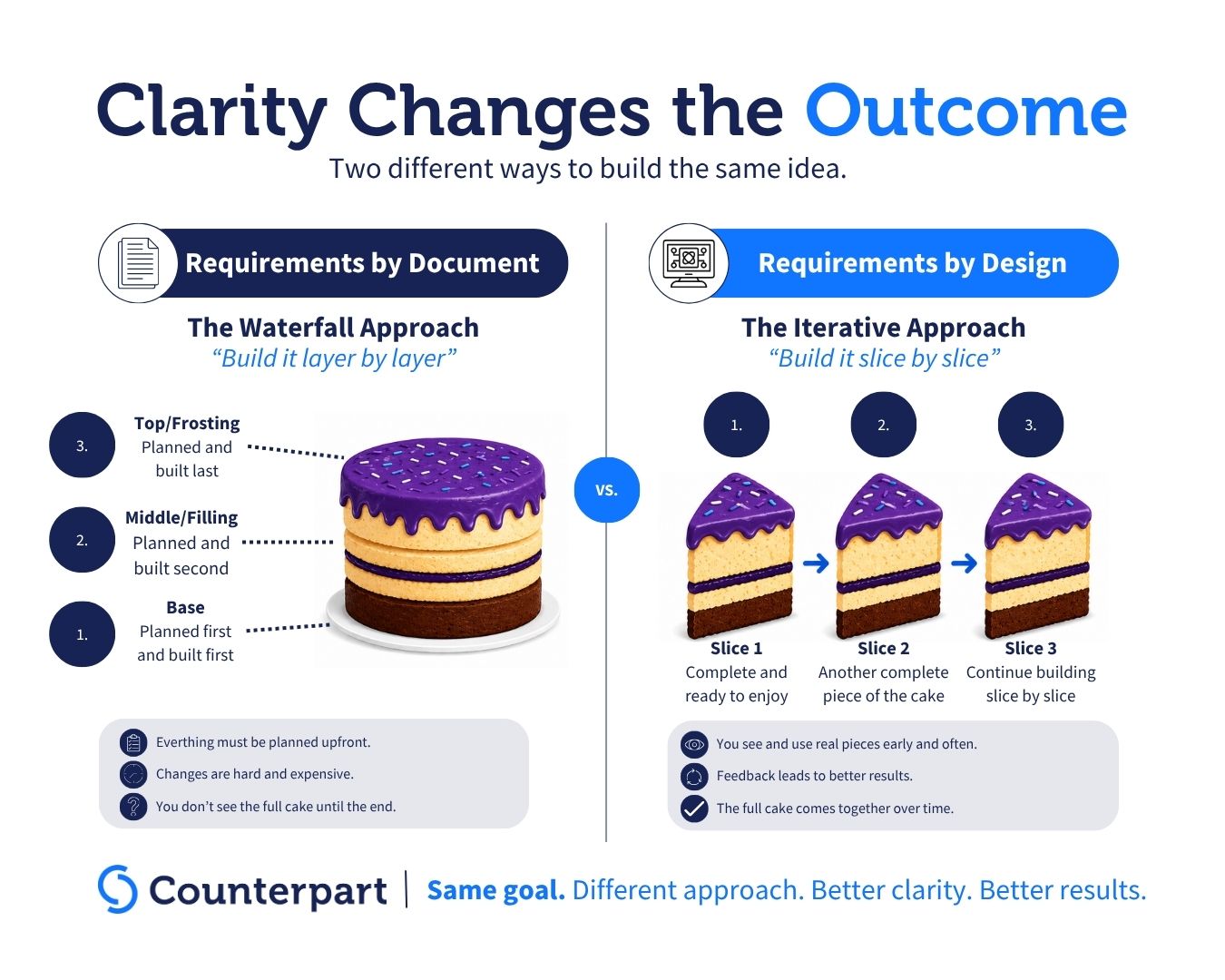
Trying to map out the entire system before anything exists may seem efficient, but it often creates blind spots. Requirements by Design works through it piece by piece. If you think of software like a cake, most traditional approaches try to build it layer by layer, which requires knowing everything upfront.
This approach builds it slice by slice.
Each slice includes everything it needs to function. In software terms, that means taking one feature and building it end-to-end. It’s designed, developed, tested, and usable before moving on to the next one. You don’t need the entire picture perfectly defined on day one. You need each piece to make sense as it’s created, with enough continuity to build toward a complete product.
With Requirements by Design, clarity starts to take shape earlier because the process leaves room for it. Initial scoping stays intentionally light. It’s there to understand the problem and outline the direction, not define every detail upfront. From there, requirements are worked through in design.
Each feature is brought to life visually before it’s built. The design becomes the working version of the requirement, something the team can review, question, and refine together. The technical side is still part of the process. Developers and architects remain involved to ensure the underlying logic, data, and integrations are accounted for. The process starts with how the product should work for the user and builds from there.
That shift tends to remove much of the ambiguity that arises when teams rely solely on documentation. People can see what’s being built, react to it, and stay aligned as it evolves.
One of the biggest advantages is how quickly teams get on the same page. Instead of waiting until later in the process to understand how something works, feedback happens early. Questions come up sooner. Gaps get caught sooner. Adjustments are easier to make. It also changes what drives the outcome.
When design leads, and development follows, the result tends to be more intuitive. The product is shaped around how people actually use it, while still being supported by the right technical decisions behind the scenes.
That balance is a big part of how we approach our work across projects, especially when we’re helping teams think through not just what to build, but how it should come together. Want to see how this applies to our services and get a better sense of our process?
If you’re working through how to define requirements for a new project or trying to get more alignment in an existing one, we’re always open to talking it through.
Posted in Innovation, Tech Talk